

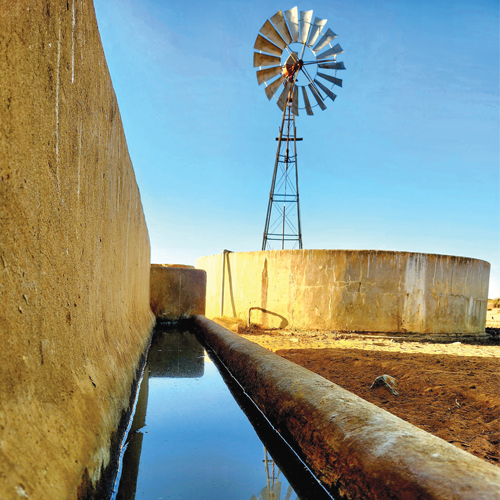

Producers in South Africa face the daunting reality of water scarcity. In arid and rural areas producers widely use groundwater, but it is important to know that water is regarded as a national asset that is protected and managed under the National Water Act (Act 36 of 1998). Almost all water resources are publicly owned, not privately, and are held in trust by the state.
Reliable water supply is at the foundation of successful farming. Without water, there is no life. Whether you are irrigating crops, watering livestock or mixing liquid fertiliser, your operation depends on reliable access to water.
Under the legal context, the producer may own the borehole and the land on which it is situated, but groundwater resources cannot be privately owned. This means that certain water uses require legal authorisation from the Department of Water and Sanitation (DWS).
Producers need to know when a water use licence (WUL) is required, as non-compliance can result in hefty penalties. This article provides an overview of what a producer needs to know about WULs. It would not be possible to capture the National Water Act in its entirety within just one article, but the article offers the most important aspects in a nutshell.
More about a WUL
A WUL is an authorisation that is granted by the DWS to the applicant (in this context, the producer) for specific water uses that were applied for under Section 21 of the National Water Act.
Authorisation conditions aim to enforce sustainable water use and hold the applicant accountable for any negligence that may occur. Where water is taken from a natural source, the licence will specify the maximum volume of water that may be abstracted within a listed timeframe.
These volumes may vary depending on which catchment your farm is located in. This means that once a licence is approved, the producer does not have permission to use water as he or she pleases, but rather to operate within the parameters set out in the relevant water use licence.
Water use authorisation aims to:
- Protect and conserve water resources.
- Support fair access to water.
- Ensure sustainable development.
- Protect natural ecosystems.
- Comply with international obligations.
This licencing system should assist the government to better keep track of how much water is used, where it is taken from and how these activities may impact the surrounding environment.
THE DIFFERENCE BETWEEN A WUL AND A GENERAL AUTHORISATION (GA)
- A general authorisation (GA) is a pre-approved, simplified form of water use authorisation that is formally gazetted by the minister of water and sanitation to allow specific water uses without the requirement to apply for a full WUL, provided that the limits within the GA are adhered to.
- This type of authorisation applies to low-risk and small-scale activities as identified by the minister. It is important to note that, although a GA provides automatic permission for specific low-risk water uses, it does not remove the duty to inform the DWS of the intended water use.
- Most GAs still require the water use to be registered with the DWS, but it is a much shorter and cheaper process in comparison to a complete WUL application.
- A full WUL is required for higher-risk water uses that may occur on a larger scale. This type of application can be lengthy and costly, as it requires specialist studies and public participation. A WUL is site-specific, detailed and legally binding to the applicant (the producer).
Farming activities requiring WULs
In terms of the National Water Act, it is easier to first identify which uses do not require a WUL. These permissible uses are listed in Schedule 1 of the Act. In terms of groundwater, a farming household may use the water without authorisation for the following:
- Reasonable domestic use.
- Small gardening.
- Watering livestock that graze within the grazing capacity of the specific land.
- Collect and use run-off water from a roof.
- For purposes of firefighting and human consumption during emergencies.
Furthermore, water use may not require licencing if it can be proven to be existing lawful water use. This means that a water use activity that was already in commencement before 1998, may not be required to apply for a WUL. However, it is recommended to verify with the DWS that the water use does indeed qualify as an existing lawful use.
Producers need to note that water use on a farm likely needs to be registered and authorised as soon as it goes beyond the small-scale Schedule 1 uses and is used for commercial farming purposes.
This means that watering grazing cattle from a borehole may not require licencing (as mentioned above), but a feedlot or dairy operation will require licencing. Your small vegetable garden at home may not require licencing, but the irrigation of commercial crop fields will require licencing.
The water uses that require licencing are all listed under Section 21 of the Act. Other uses that may require licencing within a farming context may be the following:
- Irrigation of land with waste or water containing waste.
- Impeding or diverting the flow of water in a watercourse may require a GA or full WUL.
- Constructing or enlarging dams, especially dams located on-stream, may require authorisation.
- The storage of water in dams may require a GA. The volumes allowed to be stored in such dams may vary depending on the quaternary catchment in which the farm is situated.
- Any form of construction or earthworks in or near a watercourse, including wetlands, will likely need a GA or full WUL. Many medium- to high-risk developments within 500 metres of a wetland may also require an environmental authorisation under the National Environmental Management Act.
- Any discharge or disposal of waste or effluent that may impact a water resource (including groundwater). This includes run-off from feedlots, dairies, etc.
The application process
It is important to identify exactly which water uses you are applying for in terms of the act:
- Section 21 (a) – taking water from a water resource.
- Section 21 (b) – storing water.
- Section 21 (c) – impeding or diverting the flow of water in a watercourse.
- Section 21 (d) – engaging in a streamflow reduction activity under Section 36 of the Act.
- Section 21 (e) – engaging in a controlled activity under sections 37(1) and 38(1) of the Act.
- Section 21 (f) – discharging waste or water containing waste into a water resource.
- Section 21 (g) – disposing waste in a manner that may detrimentally impact a water resource.
- Section 21 (h) – disposing of wastewater or heated water which resulted from an industrial or power generation activity.
- Section 21 (i) – altering the bed, banks, course or characteristics of a watercourse.
- Section 21 (j) – removing, discharging or disposing of water found underground if it needs to be done to efficiently continue with an activity or for the safety of people.
- Section 21 (k) – using water for recreational purposes.
A full WUL application generally takes anywhere from 300 days or more, whereas a GA registration, as previously mentioned, is much quicker, as it is a 30-day process. A full WUL will typically involve a hydrological assessment, engineering drawings, an environmental impact assessment (if a listed activity is triggered), public participation, specialist studies (if deemed necessary) and submission and review by the DWS. Producers may contact a registered environmental consultant to assist with this process.
Compliance
RISKS RELATED TO NON-COMPLIANCE
- Using water without the required authorisation from the DWS may lead to fines and/or criminal prosecution. Imprisonment for first-time offenders can be up to five years, according to the Act.
- In many cases, insurance will also not cover any remediation costs for environmental damage caused by illegal water use. The DWS may also issue the producer a directive, which basically is a formal order instructing the producer exactly what must be done to fix the issue at hand.
- The directive may require the producer to immediately stop the unlawful water use, remove or demolish structures associated with the unlawful water use, and rehabilitate the impacted environment at his or her own cost.
- If a producer refuses to cooperate with the instructions listed in the directive, the DWS has the legal authority to carry out all required remediation work and send the bill to the producer for payment. The fines imposed may be added to the remediation costs.
THE BENEFITS OF COMPLIANCE
Other than the obvious benefit of not having to pay fines or sit in jail when you maintain compliance, additional benefits may include smoother loan approvals and an increase in your property value.
Additional tips
- Keep a copy of your WUL or GA on file along with all proof of compliance. This file must be made available to the DWS for inspection upon its request.
- Seek early guidance from an environmental practitioner.
- Remember to apply for the amendment of your WUL if any ownership or scope details change.
- When in doubt, contact the DWS to advise if a WUL or GA would be applicable before you commence with a water use.
Conclusion
While the National Water Act and licencing may look intimidating to most, it exists to safeguard the country’s water resources. As a producer, it can be difficult to determine if a WUL is applicable. It is important to get acquainted with the National Water Act. If you struggle to interpret the Act, contact an environmental practitioner to assist.
Always remember: You might own the farm and the borehole equipment, but you are not the rightful owner of the groundwater beneath it. Make sure that your water uses are licenced to avoid legal and financial consequences.
References
Department: Water and Sanitation (DWS), n.d. Documents. [Online]
- Available at: chrome-extension://efaidnbmnnnibpcajpcglclefindmkaj/https://www.dws.gov.za/Documents/BROCHURE_Water%20Use%20Lisence_Outer.pdf [14 November 2025]
- Department: Water and Sanitation (DWS), n.d. Water use authorisation process. [Online] Available at: https://ewulaas.dws.gov.za/ewulaas/WUA.aspx [13 November 2025]
- Milk Producers Organisation, 2017. Guidelines to water use: Authorisation and registration for dairy farmers. [Online] Available at: chrome-extension://efaidnbmnnnibpcajpcglclefindmkaj/https://wwfafrica.panda.org/downloads/guidelines_to_water_use_authorisation_mpo_2017.pdf [17 November 2025]
- National Water Act (Act 36 of 1998)