

 The increase in soybean production over the years intensifies the need to develop management strategies that mitigate land degradation and enhance production in cropland. Moreover, over the years, new soy-
bean varieties and agronomic cultivation techniques have boosted yield potential to unprecedented levels. This emphasises the impor-
tance of nourishing the soil with essential nutrients to support sustainable long-term use.
THE soybean Glycine max (L.) Merr. is among the most valuable leguminous crops globally, contributing significantly to food security, livestock feed and industrial applications due to its high protein and oil content (Usman and Ramzan, 2025).
Soybean is a rotational crop and should always be planted in rotation with other crops, preferably monocotyledonous crops (such as maize, grain sorghum and wheat). A maize-sunflower rotation (mostly practised by smallholder farmers) is unlikely to achieve the desired effect, as the two crops share susceptibility to certain diseases (Van Biljon, 2016).
On the other hand, precipitation patterns are shifting towards wetter springs and drier summers, as indicated by Grady et al. (2021). Therefore farmers must revise soil conservation practices to optimise crop yields.
Fischer et al. (2014) indicated that optimising plant phenotypes to increase soybean productivity, rather than expanding cropland, could help achieve the broader objective of improving the food supply. Before introducing soybeans into rotation systems, consider a few key factors for successful soybean production.
Soil nutrients
Most soil micro- and macronutrients are necessary for successful soybean production. However, the following micro- and macronutrients should be sufficiently available in soybean croplands:
- Nitrogen (N)
- Phosphorus (P)
- Potassium (K)
- Sulphur (S)
- Iron (Fe)
- Boron (B)
Soybeans need adequate nutrients at each growth stage for optimum growth. Balanced nutrient application promotes nutrient retention and system sustainability, whereas imbalanced or insufficient fertilisation accelerates nutrient mining and threatens soil health (Shinogi et al., 2026).
Fields that have never had soybeans or have not had them for several years will have no naturally occurring Bradyrhizobium japonicum (a bacterium required for legume root nodulation), or levels will be too low for adequate infection and nodulation. In these instances,an inoculant seed treatment, applied directly to the seed or in-furrow, is necessary. If the plants are well inoculated, additional N application is generally not recommended. P application should always be based on a soil test.
Soybean seeds are relatively high in K, and soybeans remove more K than other crops. S is mobile in the soil (leaching is common) but fairly immobile in the plant. High soil test variability, along with
significant crop uptake, creates the need for proper sulphur management. Correct any nutrient deficiency before cultivating the crop preceding soybean in a crop rotation system.
Soil agronomic management vs soybean yield
CHEMICAL/NUTRIENT MANAGEMENT
According to Kaiser et al. (2011), if nodulation is poor and the nitrate-nitrogen level is less than 84 kg/ha up to a soil depth of 600 mm, between 55 kg and 85 kg N/ha should be applied. Soybeans remove between 75 kg and 105 kg N/ton of grain (MVSA, 2007), so using 90 kg N/ton, a 3 t/ha harvest removes 270 kg N/ha. This amount of nitrogen alone, applied in a single season, could increase production costs drastically.
Therefore, soybeans prefer soil that was previously well-fertilised and free of nutrient deficiencies, followed by inoculation of the seeds with the right inoculant for proper nitrogen fixation.
Loman et al. (2024) measured the soybean yield between 2014 and 2021, examined relationships between soil fertility parameters and the soybean yield, and reported that soil fertility mattered more for later-planted soybeans than earlier-planted soybeans. This led them to recommend late-planting soybeans in high-fertility fields and early-planting soybeans in lower-fertility fields to reduce overall fertiliser needs.
BIOLOGICAL MANAGEMENT
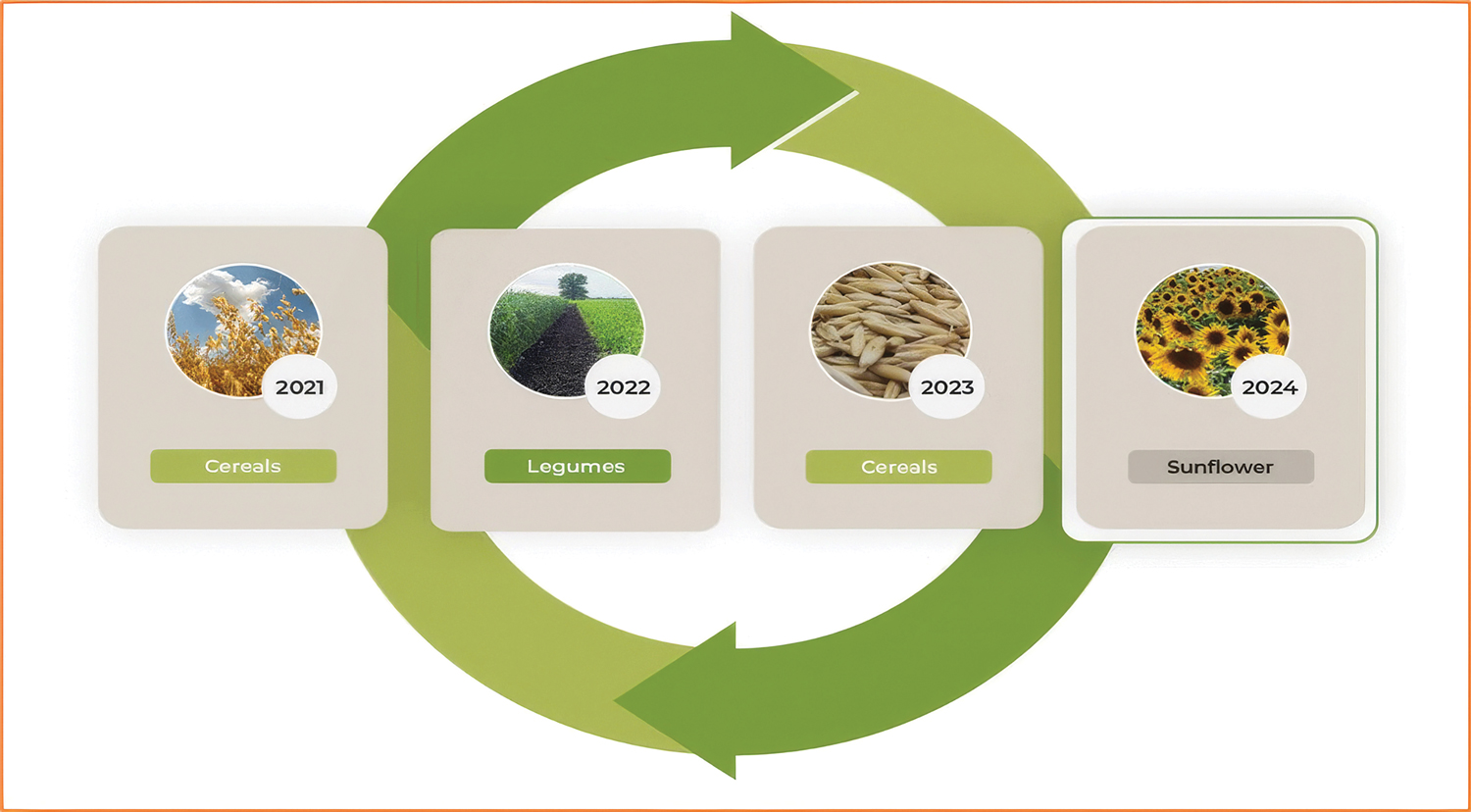
Legume-cereal rotation (Figure 1) is a worldwide practised and successful approach for managing soil fertility through crop diversity. This cycle is cost-effective and sustainable, promoting ecological intensification and economic resilience in various agroecosystems, especially for smallholder farmers under dryland farming (Yigezu et al., 2019).
Reducing root infections can substantially improve a plant’s root system efficiency, which may explain why maize cultivated after soya outperforms maize planted after maize (Van Biljon, 2016).
Legumes contribute nitrogen (N)-rich residues with a low carbon-to-nitrogen (C:N) ratio, which significantly enhances the yield of subsequent cereal crops (Watson et al., 2017). Additionally, alternating legumes with cereals (Figure 1) is a natural method of biofortification that improves the nutritional value of cereal grains.
As mentioned above, a two-year maize-sunflower crop rotation is not a solution. While it may seem like a partial solution to environmental challenges, it still retains the characteristics of monoculture and its
consequences.
Source: https://www.logineko.com/knowledge/what-is-crop-rotation-and-why-need-it/
INTEGRATED MANAGEMENT
Shinogi et al. (2026) examined how different nutrient management practices affect productivity, profitability and soil health under the soybean-wheat rotation system, and concluded that nutrient management plays a pivotal role in sustaining yield and income, particularly under rainfed agriculture.
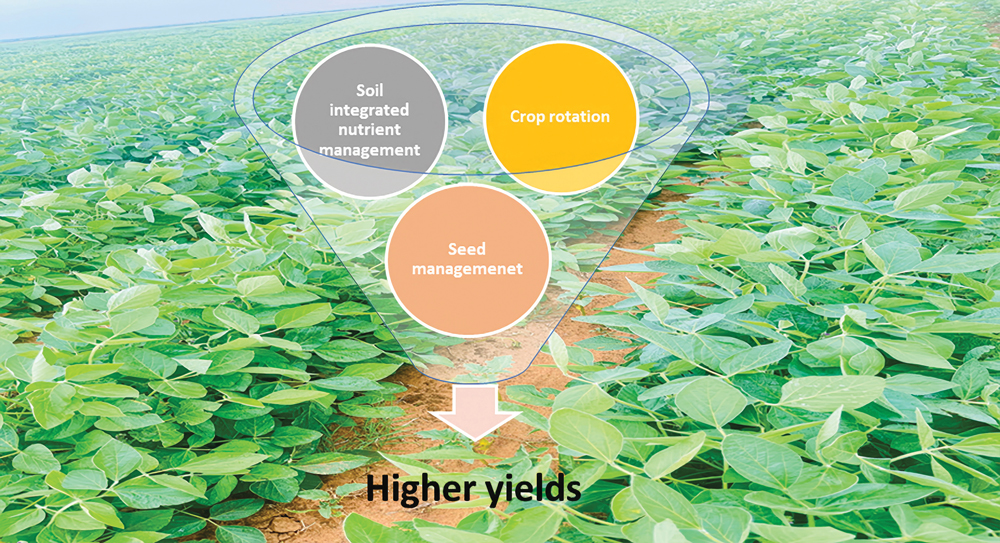
According to Choudhary et al. (2018), integrated nutrient management (INM) in soybean is a practice based on a balanced application of organic manures – farmyard manure (FYM), compost, biofertilisers such as Rhizobium and phosphate-solubilising bacteria (PSB) and chemical fertilisers based on soil testing, which optimises nutrient availability and improves soybean yields (Figure 2).
Rhizobium fixes atmospheric N and PSB helps with root development by providing more available P, which together trigger nodule formation. Biofertilisers and liquid fertilisers to address micronutrient deficiencies are available from various local and international manufacturers to promote growth and early flowering in soybean.
Summary
An improved soybean yield comes from the integration of several agronomic practices that promote soil health and enhance sustainability. Decisions about planting soybean are made a few years in advance, not a few days before the planting season begins. It usually begins with fixing your soil and addressing any deficiencies, selecting a cultivar, and using a proper Rhizobium for seed treatment.
References
- Choudhary AK, Rajanna G and Kumar A, 2018. Integrated nutrient management: An integral component of the ICM approach. In: Integrated crop management practices for enhancing productivity, resource-use efficiency, soil health and livelihood security. New Delhi: Today & Tomorrow’s Printers and Publishers. pp. 33-39
- Fischer RA, Byerlee D and Edmeades G, 2014. Crop yields and global food security: Will yield increases continue to feed the world? ACIAR Monograph 158. Australian Centre for International Agricultural Research
- Grady KA, Chen L and Ford TW, 2021. Projected changes to spring and summer precipitation in the midwestern United States. Front. Water, 3
- https://soybeanresearchinfo.com/agronomics/soybean-fertility/ Soil Fertility. Accessed 16 July. 2026
- Loman MH, Sible CN and Below FE, 2024. Soybean planting date affects the relationship between soil test values and grain yield. Soil Science Society of America Journal. 88:2194-2210
- Morrison MJ, Cober ER, Gregorich E, Voldeng HD, Ma B and Topp GC, 2017. Tillage and crop rotation effects on the yield of corn, soybean and wheat in eastern Canada. Canadian Journal of Plant Science
- Shinogi KC, Srivastava S, Radha TK, Rao DLN, Meena BP, Sinha NK, Das H, Rashmi I, Rosin KG, Singh AB, Behera KS and Mohanty M, 2026. Soil fertility management for yield and income stability in soybean-wheat rotation system under climate variability in subtropical Central India
- Usman T and Ramzan HT, 2025. Agronomic practices for soybean production under climate-resilient conditions. Department of Agronomy, University of Agriculture, Faisalabad, Punjab, Pakistan
- Van Biljon J, 2016. Nitrogen fertilisation of soya; yield-enhancing systems, Kynoch fertilisers. https://www.kynoch.co.za/wp-content/uploads/2018/09/Oilseed-Sept-2016.pdf. Accessed 18 June 2026
- Watson CA, Reckling M, Preissel S, Bachinger J, Bergkvist G, Kuhlman T, Lindström AK, Nemecek T, Topp CFE, Vanhatalo AO, Zander P, Murphy-Bokern D and Stoddard, 2017. Grain legume production and use in European agricultural systems. Advances in agronomy. Elsevier. 144:235-303
- Yigezu YA, El-Shater T, Boughlala M, Bishaw Z, Niane AA, Maalouf F, Degu TW, Wery J, Boutfiras M and Aw-Hassan A, 2019. Legume-based rotations have clear economic advantages over cereal monocropping in dry areas. Agronomy for Sustainable Development, 39(6)